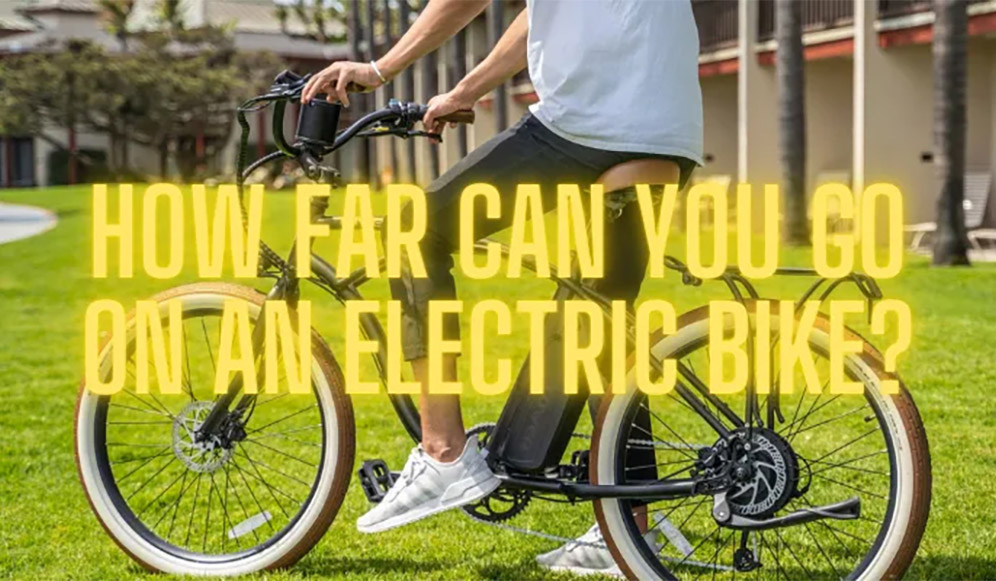
First and foremost, if your bicycle has an electric motor it is then classified as an electric bike. In the United Kingdom, you can ride on paved trails that allow bicycles but check with the local council for their rules for unpaved trails. It can vary from district to district. You can also ride an electric bike on any bike lane on the street as well as any shared paths that are reserved for bicycles and pedestrians. Any trail where motor vehicles are permitted, such as unpaved forest service roads. However, one may wonder how far is an electric bike range on a single charge? Range simply refers to how far an electric bike can go on one charge. There are many factors that determine how far an electric bike can travel. In reality, most of these factors have more to do with how you ride than with the electric bike’s specifications.
First, you need to determine the battery capacity of the long distance electric bike to determine its range. Batteries are usually measured in Watthours (Wh). Battery ratings are sometimes given in volts and amp hours, such as 48V 10Ah for an electric bike. To convert to Wh, simply multiply the volts by the amp hours. A 48V and 10Ah battery is therefore a 480 Wh battery. If you prefer kilometres or miles, you can calculate the effective range of the battery by simply dividing the watt-hour capacity by the average capacity in Wh/mi.

This is the slightly fuzzy part of the math since efficiency numbers will vary based on the factors listed at the start of this article. But speaking generally, I find that most 500-750W throttle electric bikes ridden at an average speed of 20 mph (32 km/h) on only slightly hilly terrain get me around 25 Wh/mi (or 15.6 Wh/km). Thus an electric bike of this style with a 480Wh battery would provide me with around 19 miles of range (480 Wh ÷ 25 Wh/mi = 19.2 miles).
Pedal assist will always be more efficient. I find that most pedal assist electric bikes ridden around 15 to 18 mph in medium levels of pedal assist will get me around 15 Wh/mi (or 9.4 Wh/km). Thus the same 480Wh battery on a pedal assist electric bike will provide me around 32 miles of range (480 Wh ÷ 15 Wh/mi = 32 miles). The biggest factor contributing to your range is whether you pedal or just use a throttle without pedalling, along with what level of assist you use.
Electric bikes are a strong proponent of the synergy resulting from combining human pedal power with electric power, so we’ll tell you the expected range when you do both. With relaxed pedaling expect 22-50 miles on a single charge for most electric bikes. In some cases, you’ll go even farther. We have bikes that are getting 80+ miles on a single charge. In the current market, the longest range electric bicycles can reach is 350-400 kilometres per charge. The battery of such an electric bike usually has 3kW capacity. Standard electric bikes with 400-500W batteries would ride up to 100-120 km on one charge. Simple city electric bikes would normally run 50-60 km on a single charge.
As a matter of fact, the better the battery capacity, the longer the fastest electric bike can run between charges. However, the range will also be impacted by external factors such as the hills, wind and your size. Many electric bikes pedal easily as regular bikes. So you can extend the range even further by using little or no power on level surfaces and downhill. It should be noted that efficiency drops drastically as riders gain speed because of drag. That is, “forces acting opposite to the relative motion of any object as it moves in relation to a fluid or in this case air”. The force required to drive an object through a fluid increases as the cube of its velocity, while air drag is roughly proportional to the square of velocity.
Once you reach 15 mph on an electric bike, drag starts to affect how fast you can go, giving you a much slower speed. I think electric bikes are remarkable because they compliment the human body and mind while connecting us with others. The typical low-speed electric bike won’t go faster than 20 miles per hour on a motor alone. You can always pedal faster than that or drop a steep hill. Pedal-assisted electric bikes can now reach speeds of up to 28 miles per hour if the rider pedals vigorously.